

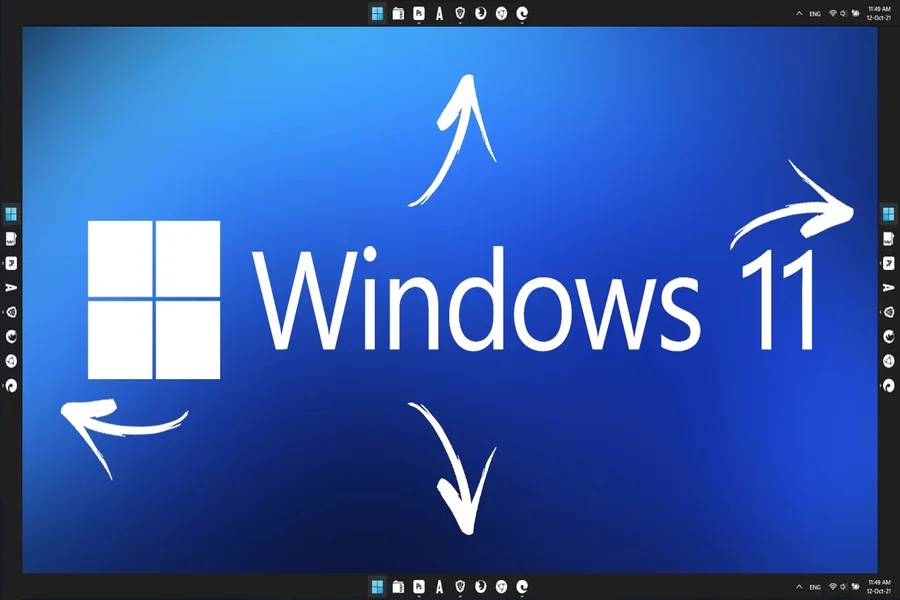
Dragging windows 11 task bar is one of the issues that many users search once they have updated their system. Windows 11 came with a new task bar design with a centrally laid out design and fewer customization features than its predecessors.
In past editions such as windows 10, users were allowed to easily drag the taskbar to other corners of the screen. Windows 11, however, altered this behavior making it less flexible by default. This has prompted most users to seek means of re-arranging or personalizing the taskbar.
The system does not technically allow taskbar to be moved to all edges, but still, there are means of changing its position and behavior. Knowing these options can assist you in forming a set-up that suit your workflow.
Default Taskbar Position and Limitations
The default position of the taskbar is at the bottom of the screen in Windows 11. You can no longer drag it to the top or sides as in the older versions.
The main customization available in the default settings is alignment. You have the option of a centered layout or a left-aligned layout, which is resembling the conventional windows appearance.
This is a restriction within the design philosophy of Microsoft, emphasizing on simplicity and consistency. Although this can suit most users, it can be limiting to some users.
These restrictions should be comprehended before any changes are tried. It helps to create realistic expectations and steers you towards the most viable solutions.
How to Change Taskbar Alignment
You can also change the position of the taskbar to the way you want it to be but not move it completely, that is, in the system settings.
To do this, right-click on the taskbar and select “Taskbar settings.” Go there, and then choose the taskbar behaviors.
You will see the respective option to switch the position of taskbar icons. When changing left to center, the icons are brought nearer to the classic design.
This minor change can result in the interface being more comfortable, particularly to those making the switch to older versions of Windows.
Although it does not alter the position of the taskbar on screen, it enhances the ease of use and comfort.
Using Registry Edits for Advanced Positioning
Registry edits are also a more advanced way of moving the taskbar and offered more control to the user.
The task bar can be repositioned at the top of the screen by changing some values in the system registry. Nonetheless, this approach is risky.
Anything that is done to the registry that is not correct may lead to the system being compromised and hence care must be taken when undertaking such work and a copy of the registry should be made.
This method is not endorsed by Microsoft and as such, it might not be effective every time one updates to the latest version.
These dangers notwithstanding, there are users who find it helpful in attaining a personalised layout.
Third-Party Tools for Taskbar Customization
The third-party software to move a taskbar in Windows 11 is another method. These tools offer more customization options not found in the default system.
Taskbar customization programs can enable you to relocate the taskbar to various sides of the screen, alter its looks, and introduce new features.
These tools could have easy to use interfaces so it is easy to make changes to settings without having to toggle complex settings in the system.
Nonetheless, one should select good software that is supplied by credible sources. There is a possibility of security threats such as the use of unknown tools which may impact on the system performance.
Flexibility is provided by the third-party solutions but it must be applied cautiously.
Tips to Improve Taskbar Experience
You can always add to this, even though you are unable to move the taskbar all the way.
You may choose what kind of icons you want on the taskbar so that you can access the applications that you use most of the time.
The usability could also be enhanced by adjusting the size and behavior of taskbars. To illustrate, auto-hiding can be turned on to spare up the screen space.
Virtual desktops can assist in organizing your workflow, particularly in case you have various applications.
Apps can be pinned on the taskbar to be easily accessed and avoid the use of search in the menus.
Such minor changes can go a long way in influencing your brush with your machine.
Common Issues and How to Fix Them
You are likely to come across some common problems when customizing taskbar.
One of them is that settings are not applied properly. This can be overcome by restarting your system.
After updates to the system, registry changes might not be useful. In these instances you might have to retract the changes or resort to other procedures.
Conflicts can occur with tools of the third-party. The compatibility with your system version is an advantage which can be used to prevent these problems.
In case the taskbar is not responsive, one can restart the windows explorer process to rectify the problem.
These are some of the frequent issues that you can understand to troubleshoot.
Final Thought
Moving taskbar in Windows 11 may not be as straightforward as in previous versions, but there are still ways to customize your experience. Although the system restricts direct movement, it offers flexibility with alternatives such as adjusting the alignments, making changes to the registry and the availability of third-party tools.
The trick lies in striking the balance between customization and stability. The safest and most reliable are simple adjustments in the system settings.
Advanced techniques should be used to obtain a customized configuration to those who require more control. Nevertheless, one should take things step-by-step and be aware of the dangers.
Finally, the desired outcome is to make the workspace a comfortable and efficient environment. It is possible to get Windows 11 to behave in a manner you like with the correct approach.
